
Working in a PPPP to improve the environment of Bucharest – Bucharest Community Foundation
Section
Background
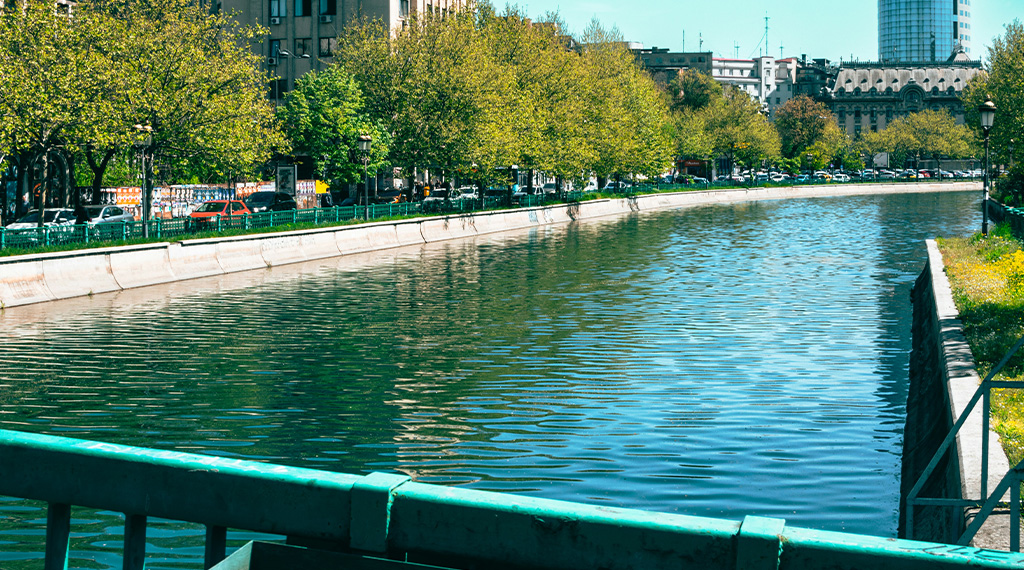
Nobody is responsible for the river that crosses Bucharest. Fourteen institutions each hold a piece of the Dâmbovița, and none has an overview. The water itself is managed by Romanian Waters. The cement riverbed belongs to the municipality. The shores are shared by four of the six districts. As a result, the river looks increasingly neglected: Trees are dying, trash piles up in the water and on its shores, and people pass by without ever noticing the river is there.
But it does not have to be this way.
If changed, it could become the city’s cooling element, lowering temperatures in its vicinity by 3 to 6 degrees; absorbing part of the inevitable pollution; giving inhabitants a place to spend quality time; and becoming a sanctuary for urban biodiversity. Other European cities have done it successfully in recent decades.
The city has more environmental reasons to hurry than the river alone. According to surveys of the Romanian Institute for the Quality of Life, people in Bucharest lose up to four years of potential life because of pollution-related problems. The city has less than the minimum green surface per inhabitant recommended by the World Health Organization, air quality limits are breached on too many days a year, and when it comes to traffic, Bucharest ranks annually among the worst five cities in the world, according to TomTom surveys.
As for the river, only a consortium of institutions working together in a coordinated manner could save it and offer it back to the city. But who could spark the idea, and lead the building, of such a consortium?
Context
The Bucharest Community Foundation (BCF) is a local fundraiser and grantmaker. We work with local donors, mainly companies, to open funding for non-profits and informal initiative groups in areas relevant to the community.
For years, we tackled the environment in the simplest way, through named funds for different donors. When a donor changed its priorities, or the funding went dry, environmental issues were paused until the next opportunity. For an issue of such impact on the community, that was not acceptable.
We considered a themed programme for the environment, funded by multiple donors, to ensure continuity. But the river, and other complex environmental problems, show why even that would not be enough: Several donors together still do not make up for the lack of a true overview.
There was a deeper reason that nobody had tried to take action before. According to successive Eurobarometers, less than 20% of Romanians trust people outside their close circle, while in Scandinavian countries the share is in the 80s. This is valid not just for individuals, but it is also built into institutional cultures. And yet, a moment of breakthrough was possible, in the midst of a deep crisis.
Origins of the Platform
In 2020, when Covid threatened lives, a swift countrywide partnership emerged between various public and private entities to address and minimise the emergency. The crisis became a catalyst for trust and cooperation among civil society, corporations, and the administration. That we could act together, fast, was a proof of concept for further attempts.
This fuelled an idea bolder than a themed environmental fund: What if we could bring together all parties interested in, and responsible for, the environment in Bucharest, to solve these complex issues together?
At just about the same time, ING Bank, our long-time donor and a corporate partner during the Covid response, was looking for a similar approach to urban environmental issues. We began by researching the field together; its issues, its stakeholders, and the methods that could bring them to the same table. That is how we arrived at collective impact, an approach for problems too complex to be solved by any single party in a community; a network of community members, organisations and institutions that learn together, align and integrate their actions to achieve systems-level change. In 2021, we launched the Platform of Environment for Bucharest.
The Platform
The Platform is built on four pillars inspired by the collective impact framework:
- Research. A report on the state of the environment, published regularly. Built on curating and explaining public data, it helps prioritise issues and allows data-driven decisions and impact measurement across a variety of organisations. Two reports have been published; the second was developed in partnership with City Hall.
- Private funding and capacity building for projects that create solutions to environmental priorities. Donor companies run their own funding rounds in the Platform or contribute together to a common pot, according to their priorities. The funding decision is made by an independent jury of experts in partnership with the respective donors, while BCF follows up on implementation and on the efficient use of resources.
- Community and public policy. A community of more than 80 organisations and stakeholders around a common agenda, with activities that reinforce each other, from projects that build on one another to gathering a constituency that pushes public policy forward.
- Backbone organisation. BCF acts as a neutral convener, having earned the trust of stakeholders who know that it puts community welfare above other interests.
In public-private-philanthropy partnership (PPPP) terms, the private partners are the companies; the public partners are City Hall, the district halls and other environmental institutions; and philanthropy is BCF.
Results after five years
In five years, the Platform funded 68 projects with a total of €4.4 million, from small community gardens to large urban natural reserves. The budget for funding grew from €60,000 in 2021 to more than €2 million this year.
One project is Pajiștea Petricani, a green area between apartment blocks, now recognised as a protected natural area of local interest. The multi-year project is carried out by Asociația Parcul Natural București, which aims to put four more urban natural areas, about 1,400 hectares in total, in the process of protection.
The Platform has published two environmental reports, and its members have supported improvements in public policy, from bike lane infrastructure to climate refuges in public buildings.
Most recently, we started a partnership with City Hall for large projects, such as the set-up of low-emission zones and the remaking of the largest park in the city.
Case example: The Dâmbovița River
The Dâmbovița story started modestly; a six-month project on the river, funded by the Platform. A cluster of organisations gathered around it and brought in some public institutions. Seeing its potential, the Platform offered funding and facilitation for a structured collective impact process, and multiple stakeholders joined. Then a private donor realised the strategic impact of the project and offered a large multi-year grant, complemented by a substantial marketing budget. Other donors chipped in.
Four floating piers were built on the river, and boating and rowing events took place throughout that summer. As the people of Bucharest befriended the river, the mayor took notice. He publicly committed to transforming it, and a working group with a medium-to-long-term mission was established.
Its end goal takes us back to where this story began. The group is working towards a Zonal Urban Plan that would allow the river to be partially or fully renatured, and that would formally name one custodian for it. The aim is to go from fourteen institutions with jurisdiction over parts of the river to one.
Conclusions
The multi-stakeholder endeavour of the Platform is a continuous learning process:
Working with the public administration required learning each other’s languages, cultures and limitations. It took us months of fruitless budget meetings with a district hall we were financially supporting on a project to understand that our financial logics, both arising from the legislation that regulates us, run on different tracks. Private donors scrutinise every cent invested in a project, while the local administration cannot change the budgetary terms once a project has been awarded to a contractor, irrespective of market conditions.
Partnering with multiple companies meant offering quick results for quarterly board meetings while holding the longer-term interest of the city. We made value propositions for each company’s need for recognition and impact, and brought different industries together around a purpose larger than any single one of them.
Funding civil society with limited implementation power took patience with capacity building, and a firm eye on measurable impact. We scouted promising ideas, had tough scale-up conversations and secured strategic multi-year funding in a competitive environment.
An organisation attempting a similar challenge should start with a very low personal ego, have long-term resources, be patient with large-scale impact, and be ruthless about demonstrating continuous achievement. Above all, it should fall in love with solving the problem at hand, rather than try to force its own solutions.
On the river, that meant staying out of the question of ownership. So who sparked the consortium the river needed, the working group that today brings so many institutions to the same table? Nobody owned the river, and we did not try to. What the Platform offered was a seeding fund, trust and patience, and a table.

This article was commissioned as part of Empowering Philanthropy Infrastructure for Change (EPIC), a project co-funded by the European Union.