The future as responsibility: How intergenerational fairness can help European funders meet the moment and renew hope

The future is everywhere, and yet strangely absent from responsibility. It dominates contemporary policy language (polycrisis, risk management, resilience, security doctrines, preparedness) but it is still rarely treated as something we actively owe to younger and future generations. This tension between the future as danger and the future as responsibility matters: how we frame the future shapes what we protect, what we invest in, and who ultimately bears the cost of inaction. Intergenerational fairness is the missing bridge and philanthropy has a crucial role to play in building it.
The future: more than just a design principle
Much of Europe’s recent investment in foresight and anticipatory governance – its ability to anticipate long-term change and coordinate institutions accordingly – has focused on risk. This reflects a decade of overlapping crises, from financial instability and climate disruption to war at the EU’s borders and democratic erosion, pushing institutions to prioritise shock propagation and risk containment.
In parallel, a different conversation has gained momentum: intergenerational fairness. Rather than responding to shocks, it centres stewardship, asking how decisions made today distribute benefits and burdens across time, and whether institutions remain fit for purpose amid long-term demographic, ecological, social and technological trends, offering new possibilities to unlock policy challenges that have remained structurally stuck for decades – from climate action and housing affordability to education, health and economic planning.
These two logics have largely evolved apart. That separation is now a problem. Systemic risks are not generationally neutral. When infrastructure decays, climate impacts compound, debt accumulates, or trust erodes, the long-term costs fall disproportionately on younger generations and those not yet born. Failing to act shifts risk forward in time – the core mechanism of intergenerational unfairness.
Reconnecting these approaches is essential and treating the future as a governance principle means embedding anticipation within a clear framework of intergenerational responsibility, so that managing risk is inseparable from how benefits and burdens are allocated across time.
Going forward: acting for the wellbeing of current and future generations
The UN Declaration on Future Generations, annexed to the Pact for the Future in 2024, marked a turning point. For the first time, governments committed not just to thinking about the future, but to building whole-of-government approaches to safeguard it. The question is no longer only how to anticipate change, but what institutional infrastructure is needed to keep governance systems fit over time.
This shift mirrors SOIF’s own trajectory. Like many foresight organisations, our early work focused on capability-building and targeted interventions: training policymakers and supporting governments and organisations in stress-testing strategies and designing participatory futures processes. This helped move some institutions beyond reactive crisis response and supported the emergence of a new generation of foresight practitioners and leaders – many of them young – now active across society. Together, they represent a growing, distributed capacity to think with the future in mind.
Over time, however, a clear pattern emerged. The challenge is no longer capacity and interventions alone, but connection: linking innovations, actors and logics that remain siloed.
Across Europe, institutions are experimenting – often in parallel – with new ways of relating to the future. Parliamentary committees for the future, commissioners for future generations, legislative generational checks and citizens’ assemblies coexist with multiple efforts. Political leadership operates uneasily within this fragmented landscape: aware of long-term risks and generational tensions, yet constrained by electoral cycles, crisis-driven agendas and polarisation.
Without connective infrastructures and narratives that make intergenerational responsibility politically legible, however, they struggle to accumulate into durable change.
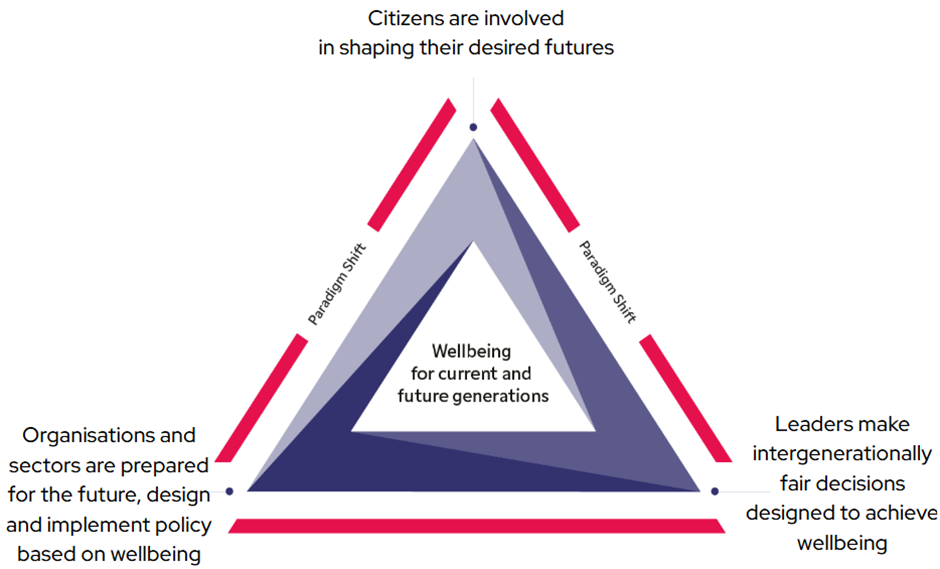
To help bridge these silos, SOIF has developed as part of its Long-term Governance programme the Foresight Governance Prism – a framework that aligns anticipatory capacity with intergenerational responsibility. It recognises that long-term governance is an ecosystem spanning political leadership and mandates, institutional and legal architecture, civic and youth participation and foresight capability embedded in public administration.
The role of philanthropy: from “future-proofing” to birthing a transformed future
From close work with foundations across Europe and beyond, distinct levels of ambition are visible in how philanthropy engages with the future. The first stage typically uses futures thinking to stress-test strategies and portfolios. The second focuses on internal capability-building, embedding long-term and anticipatory thinking into organisational intelligence. The third stage – investing in ecosystem-building, narrative renewal and governance transformation grounded in intergenerational fairness – is where momentum most often stalls.
This is not a question of commitment or resources, but of prevailing impact logics. Time-bound grants, narrow theories of change and a strong bias toward short-term, measurable outputs make it difficult to sustain the slow, relational work required to build shared infrastructures, coalitions and narratives across socio-political systems.
Yet this is precisely what the current moment demands. Europe faces an interregnum shaped by demographic ageing alongside youth precarity, declining institutional trust, the erosion of “third spaces” between state, market and society and deeply contested narratives about the future itself. In this context, incremental foresight is no longer sufficient.
What is needed is collaborations that reshape how societies relate to the future, how risks are governed and how responsibilities are shared across generations.
Philanthropy is uniquely positioned to support this shift. It can engage in sustained experimentation, support civil society and youth actors as co-designers of long-term governance and renewed narratives and fund connective tissue. But this also requires foundations themselves to walk the talk – to act as good ancestors in how they strategise, programme, invest, partner and measure impact.
This also means supporting grantees to integrate long-term thinking and anticipatory capacities into organisational practices, rather than treating the future as a thematic add-on. It also means standing alongside sectors that are both essential and under strain and helping them reimagine credible, alternative futures at a time when they are often besieged by short-term pressures and polarisation.
The future will always involve risk. But if it is treated as a shared responsibility, philanthropy can help challenge entrenched assumptions, acknowledge institutional limitations and renew the ways we organise change in service of more just and sustainable futures.
Authors