The city we want to live in by 2050: Using philanthropy to shape the future
Two visions of tomorrow’s city
What image of the city do we project into the future?
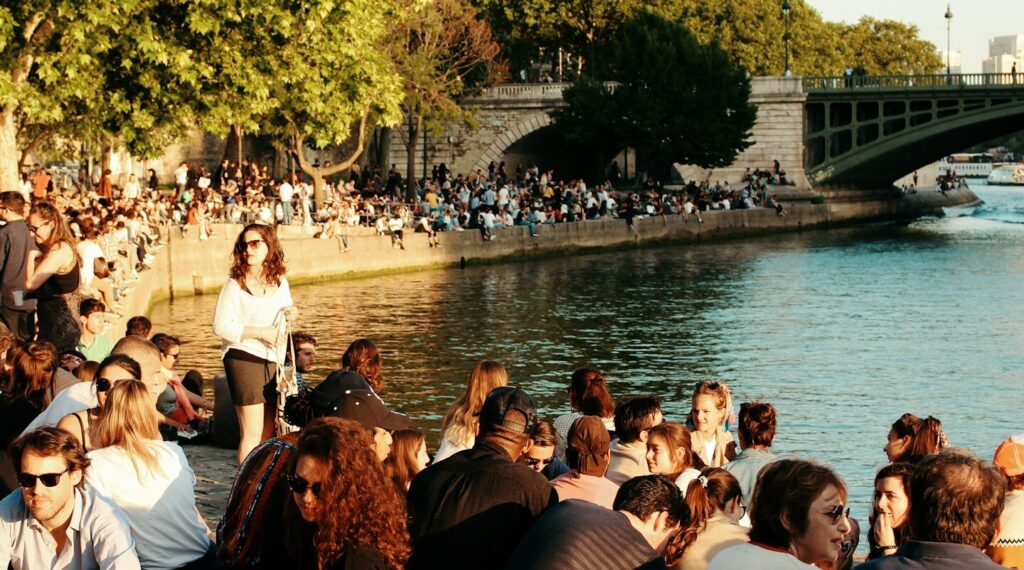
Two visions compete. The first, the one we are working toward, is the inhabited city: dense, mixed, alive. A city that holds together in times of crisis because its social fabric has been woven over decades, where you know your neighbour, where you know who to turn to. A city built around the moments when happiness comes from being together.
The second vision – the one that will impose itself if we fail to act – is the extractive city. A city as commodity, emptied of its modest inhabitants, peopled with visitors who consume its spaces. A city of second homes for the happy few who pass through without truly living there. A city where those who work and keep it running have been pushed out. Is that really the future we want?
As early as the 14th century, in the Palazzo Pubblico of Siena, Ambrogio Lorenzetti’s fresco reminded those who held power and capital that their choices had tangible consequences for the future of the city – and that they bore responsibility for them.
A vocabulary we need to recover
That civic responsibility is what we need to recover. In our democracies, just as in the small Sienese republic, those who prosper in the city are its citizens – and citizenship carries obligations. The Romans had a precise word for it: liberalitas. The generosity owed by those who thrive to the city that makes their prosperity possible.
That vocabulary is not extinct. It surfaces in moments of crisis. When Notre-Dame burned, nearly one billion euros were pledged within hours. The constraint is not the availability of capital. It is its alignment over time. Private capital remains willing to engage – but it engages on its own causes, within frameworks it does not share with public authorities. Public authorities, in turn, act within their own remit, with their own means, without exchanging lessons learned or recognising the private initiatives unfolding alongside them. Each side seeks what the other has, with no space or framework to talk and act together.
The capacity exists. But it does not reproduce itself spontaneously. Three structural obstacles make this kind of alignment rare: Short-term impact measurement excludes transformations that unfold over twenty years; Electoral cycles compress engagement horizons; and above all, the absence of a shared political narrative over time prevents coalitions from holding beyond the event that created them.
Our task is to paint the modern version of Lorenzetti’s fresco in our shared imagination. To show what the city of 2050 will look like if we act, and what it will look like if we do not. And to call on those who benefit from the city to act, over the long term, through their engagement, as citizens of a city we can inhabit together.
What the games proved
The city we want is not a utopia. Over twenty-nine days of the Paris 2024 Olympic and Paralympic Games, we proved it was both possible and worth wanting.
As chief of staff to the Deputy Mayor in charge of the Games, I witnessed what allowed us to make this far more than a sporting event. It was an operational coalition between the City, the State, businesses, and civic actors, built around a political ambition set as early as the candidature bid in 2015: deliver Games that were leaner, located in the heart of the city, designed with and for residents, and that would transform Paris for the long term. Because that ambition was set early and publicly, every actor came to treat it as a precondition rather than a request. That is what produced the cascading effect.
The Seine became swimmable, thanks to the connection of thousands of homes to the sanitation network and the construction of the Austerlitz basin – the equivalent of twenty Olympic swimming pools – which prevents wastewater discharge during storms. River biodiversity, which had collapsed to just two fish species in the 1970s, now counts more than thirty. Three public swimming sites opened by summer 2025. One hundred and twenty kilometres of new cycle lanes were built and kept in service. La Porte de la Chapelle, one of the most disadvantaged neighbourhoods in Paris, was transformed with its residents. One lane of the Paris ring road is now dedicated to carpooling – the first step toward its conversion into an urban boulevard.
What worked through that extraordinary event must now work over twenty five years. That is the ambition of the Paris 2050 Fund and its architecture: a framework that anchors long-term commitment around a shared horizon, organises it without capturing democratic decision-making, and survives political cycles.
Three principles of the Paris 2050 Fund
The Paris 2050 Fund answers this ambition and positions itself as the continuator of what the Games proved possible. It rests on three interlocking principles:
1) Long horizon – Twenty-five years – long enough to outlast electoral cycles and annual budget arbitrations and to show its true effects.
2) Defined territory – The challenges that converged in Paris – heat, inequality, mobility, social cohesion, biodiversity – are the same that every major European city is facing. Succeeding here, under Parisian constraints of density and heritage, means producing a transferable model.
3) Civic alliance – The Fund’s governance is tripartite: public authorities, committed private donors and independent figures. No party decides alone. The structure protects democratic decision-making – the City remains accountable to its voters – while organising the durable engagement of private capital around the priorities the public has identified. It is this structured, continuous dialogue that has been missing.
A European family, a Parisian shift
Paris 2050 is not an isolated case. It belongs to a European philanthropic tradition that has, over the past twenty years, been experimenting with new forms of urban engagement that go well beyond traditional grantmaking.
Fondazione Cariplo, in Italy, demonstrated that well-placed philanthropic capital can catalyse far greater financial flows. Thirty million euros invested in social housing triggered nearly three billion euros of institutional investment and made it possible to house more than twenty-five thousand families. The Social Impact Fonds Rotterdam, led by Bart Meijs, has shown that a coalition of private actors can hold together over time by building its learning as it goes.
These two cases prepared the ground. The Paris 2050 Fund extends that tradition and adds three shifts.
- The city as governance partner, not just beneficiary – Public authority does not simply receive funding, it co-builds and accepts accountability for the commitments it makes within the Fund.
- The ‘horizon of transformation’ – Cariplo acts on housing, Built by Nature acts on sustainable construction. Paris 2050 is not defined by a sector but by a horizon of transformation: the city we will want to inhabit by 2050. This makes it possible to fund what does not fit any sectoral category – cross-cutting demonstrators, scaling, the extra ambition.
- Single territory of action: Paris. One place, and the responsibility to produce here the evidence that can then travel.
Fluctuat nec mergitur – battered by the waves, she does not sink. The motto of Paris reminds us that the city has only held together because, in every era, its citizens accepted to be responsible for it, not merely beneficiaries. That is what the Paris 2050 Fund sets out to organise: so that Paris remains, tomorrow as yesterday, a city where we choose to live together.
Authors