
Romania’s philanthropy: Rebuilding a philanthropic culture after rupture
Compared to regions with deep traditions of organised giving – like the U.S. or Western Europe – Romania’s philanthropic sector is young. In 1989 communism collapsed, following nearly 50 years of authoritarian rule that crushed independent civic efforts. Romania then began again almost from scratch: no family foundations, no culture of structured generosity.
Yet the historical roots of giving had not disappeared entirely. In the early 1800s, wealthy families founded Bucharest’s first public hospital, Filantropia – demonstrating an early model of community-supported healthcare. Later, in the 1880s, a nationwide public campaign “Dă un leu pentru Ateneu” (“Give one leu for the Athenaeum”) mobilised ordinary citizens to contribute small sums toward the construction of the Romanian Athenaeum.
Between 1947 and 1989, the communist regime reshaped social life under enforced “collectivism.” Volunteering ceased to be voluntary and became obligatory state activity. Communities weakened, trust among citizens eroded, and private initiative was discouraged. The long-term effect was paradoxical: a society officially organised around collective ideals but marked by social isolation and distrust. These dynamics left deep imprints on civic engagement and attitudes toward giving. In Romania’s young post-1989 democracy – scarce in local wealth and rich in institutional distrust – civil society heavily relied on foreign foundations (mostly American, by the time of Romania’s adhesion to the EU in 2007), and then on EU grants. This type of funding was considerably easier to secure than building support from individual or corporate donors, and that imbalance slowed the development of domestic philanthropy for years.
A shift began in the early 2000s, as philanthropy gradually consolidated. Infrastructure organisations such as the Association for Community Relations played a key role by promoting fundraising practices, launching communication campaigns and introducing innovative tools like Direct Debit and SMS donations.
Momentum accelerated with the introduction of income tax redirection for individuals (commonly known as the “3.5% law”) which gave citizens a simple fiscal mechanism to support NGOs. This legal change made philanthropy more visible, accessible and more widely practiced. Currently, 42% of Romanian taxpayers used it in 2025, while nearly 70% have used it at least once.
Philanthropy today: the architecture of giving
Romania’s philanthropic landscape has evolved beyond episodic acts of charity; it is increasingly about institution-building and long-term impact. Today more than 127,000 registered NGOs contributing approximately 4 billion Euroto the local economy (around 1.5% of GDP). This evolution is anchored by key infrastructure actors like the Association for Community Relations (ARC) and Civil Society Development Foundation (FDSC), which have turned civic spirit into a professionalised force for good.
Over the last decade, the country has leapfrogged from fragmented charity to a sophisticated, high-impact ecosystem. Today, Romania stands as a vibrant laboratory for philanthropic innovation in Central and Eastern Europe.
Romania’s philanthropic ecosystem is increasingly structured around complementary channels of giving – individual, corporate and community-based – each contributing to a more diversified and resilient resource base.
The Power of Individual Giving – Romania has mastered the art of “Retail Philanthropy.” Over the past decade, accessible tools such as recurring SMS donations and direct debit have normalised everyday giving. In 13 years, NGOs have raised more than €102 million through 44 million SMS donations and over €21 million via direct debit. According to Association for Community Relations, one in four Romanians is an active donor; in urban areas and over half of adults have donated at least once.
The most visible example is Dăruiește Viață ” (Give Life) campaign, which mobilised 350,000 individuals to build Romania’s first pediatric oncology hospital financed entirely through private donations – demonstrating the scale citizen-led giving can achieve.
Corporate Giving – Corporate philanthropy has been strengthened by a 20% profit tax redirection mechanism, allowing companies to allocate part of their tax to non-profits. This incentive has shifted business engagement from sporadic sponsorships toward more strategic, impact-oriented partnerships.
Community Roots & Major Donors – One of the most distinctive features of Romanian philanthropy is the deliberate construction of a national infrastructure ecosystem. Initiated by the Association for Community Relations, this effort brought together – for the first time in Romania – three major private funders, the CEE Trust, the Charles Stewart Mott Foundation, and the Romanian American Foundation, alongside a consortium of local organisations under a shared, long-term strategic vision: to build a sustainable philanthropic ecosystem.
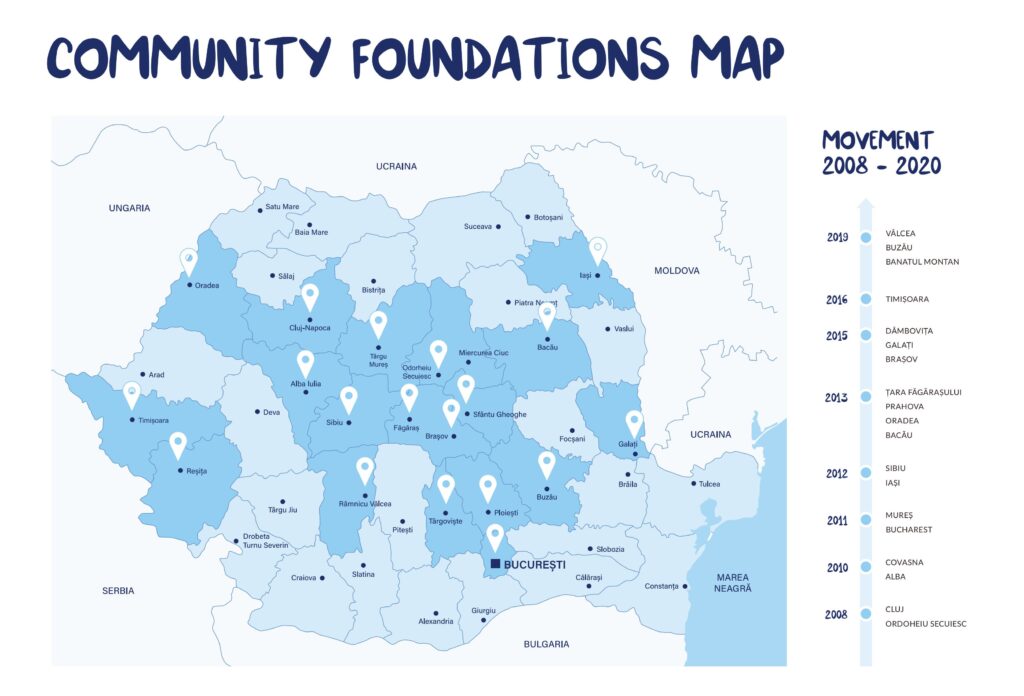
Seventeen years later, that vision has materialised into a network of 16 community foundations and their national federation. They successfully manage to mobilise resources, linking local needs with local wealth. In 2024 alone, this ecosystem mobilised approximately $10 million to support local communities. In a country where modern philanthropy had to be rebuilt from the ground up, this coordinated, long-term infrastructure investment stands as one of the clearest examples of strategic ecosystem development in action.
For major donors, corporate foundations – including those of Vodafone, Orange and UiPath -provide structured vehicles for strategic giving. The professionalisation of this process is accelerated by ARC, which provides expert consultancy and specialised training through its “Fundraising School,” ensuring a rigorous connection between major donors and high-impact projects.
Together, these mechanisms illustrate a sector moving from fragmented generosity toward a more diversified and institutionalised system of philanthropy.
Legal framework – A friendly philanthropic legislation shaped by sustained advocacy from civil society organisations and matched, at key moments, by political openness, gave additional momentum to the sector, particularly in strengthening corporate giving. Clearer regulations and fiscal mechanisms encouraged companies to move beyond one-off sponsorships toward more structured and strategic engagement. This shift broadened the financial base available to NGOs and reinforced collaboration between the non-profit and business sectors.
Opportunities ahead
Romania’s philanthropic sector is entering a decisive moment. It must strengthen its resilience – but it also has real momentum on its side.
Recent data from February 2026 shows that one in two Romanians trust NGOs, and the share of individual donors continues to rise – 29% in 2025 compared to 24% in 2023. This growth has occurred despite periodic public attacks on civil society. It signals something important: solidarity is deepening, not retreating. More people are willing to stand behind causes they believe in. This confidence is reinforced by a strong national network of philanthropic organisations whose credibility anchors local engagement.
At the same time, donor education is expanding. Individuals and companies are learning to give more strategically – through recurring donations, crowdfunding, community funds and corporate matching mechanisms. Supportive legislation has strengthened corporate fundraising, helping shift business engagement from sporadic sponsorship to more structured social investment. As giving becomes more informed and intentional, its long-term impact increases. The next frontier is data. If organisations invest in better measuring and communicating their results, they can counter scepticism, attract broader partnerships and reinforce public trust. Romania’s opportunity now is clear: convert growing trust and donor participation into a more strategic, evidence-based, and collaborative philanthropy capable of sustaining impact beyond moments of crisis.
This piece was a collaborative effort by the following authors:
From ARC:
Dana Pîrțoc – Executive Director
Ela Bălan – Director of Grantmaking
From the Romanian Federation of Community Foundations:
Laura Popeea, Executive Director
Monica Jac, Capacity Building & Development Manager
From the Romanian American Foundation:
Diana Berceanu, Philanthropy and Civil Society Director
Ruxandra Sasu, Senior Program Manager