Inclusive by design: Unheard emotions in democratic processes
‘In a world where rationality reigns supreme, who needs to bother with those annoying feelings? Why waste time analysing something so intangible when we have solid, concrete data on institutions and policies? Who cares if people feel disillusioned, fearful, or resentful toward democracy? Surely, that won’t manifest in their voting behaviour or their trust in democratic institutions?’
These questions open a recent Philea report on the root causes of democratic backsliding, pointing to a critical blind spot in our current political landscape. While we often obsess over the symptoms – the lurch toward populist leaders, widespread xenophobia and extreme polarisation – we rarely dive beneath the surface of the iceberg to address the hidden drivers: unmet needs, unheard emotions, and systemic failures.
The first two layers of this iceberg are relatively familiar to the worlds of philanthropy and public policy. Economic, educational and health inequalities are rising across Europe and the globe. The 2026 Global Inequality Report warns of extreme gaps: education spending per child in wealthy regions is forty times higher than in Sub-Saharan Africa, and the richest 10% are responsible for 77% of emissions linked to capital ownership. Systemic failures show up in the form of ineffective institutions, corruption and a lack of meaningful citizen participation. However, identifying and quantifying ‘unheard emotions’ presents a greater challenge. As the Philea report notes, research increasingly shows that emotion significantly shapes how individuals perceive and interact with their political environment. Discontent, distrust and disillusionment, and by contrast, the feelings of belonging, hope, or joy, are not “noise” in the system; they are the pulse of democracy itself. To ignore these emotional currents is to ignore the very foundations upon which democratic trust is built.
Common democratic practices – from traditional elections to innovations like citizens’ assemblies – are vital, yet they often suffer from a rational bias: privileging speech, reason and the idea of an objective truth. Most deliberative mechanisms are designed as verbal and academic exercises: participants are expected to sit still, listen to ‘experts’ and engage in calm, rational debate. For those whose lives are defined by generations of unmet needs or systemic exclusion, and for anyone directly impacted by the subject matter, being asked to detach emotionally from lived experience may feel difficult, or even absurd. By prioritising rational deliberation as the only legitimate form of evidence, we inadvertently replicate traditional power dynamics based on class, race, ability and gender, further silencing the voices democracy needs most.
To address this, we must reconsider how we include unheard emotions in democratic life. These emotions are not errors to be corrected through better communication; they are constitutive of the human experience. When we attempt to cleanse the democratic space of emotions to make room for arguments, those affects do not disappear; they rot beneath the surface, eventually manifesting as apathy, polarisation or even violence.
It’s not simply about combating citizen disengagement, however. We need to acknowledge unheard emotions as essential information to understand our political reality. We notice nostalgia – the longing for a past security that no longer exists. There is loneliness, the fear of living without a safety net. There is shame, which happens when people blame themselves for systemic failures. These feelings fuel impotence: the frustration of seeing that institutions do not respond to people’s needs.
On a more active level, we see indignation, which can transform the recognition of injustice into an ethical force for change. Perhaps the most unheard emotion today is enthusiasm. Although institutions often view it with suspicion, enthusiasm is an expression of joy that comes from discovering our shared potential; or the surprise of an innovative social intervention. The goal of democracy is not to ignore these emotions, but to treat them as evidence for action. When they are truly heard and engaged, loneliness can turn into community power, and indignation can be transformed into a tangible policy proposal.
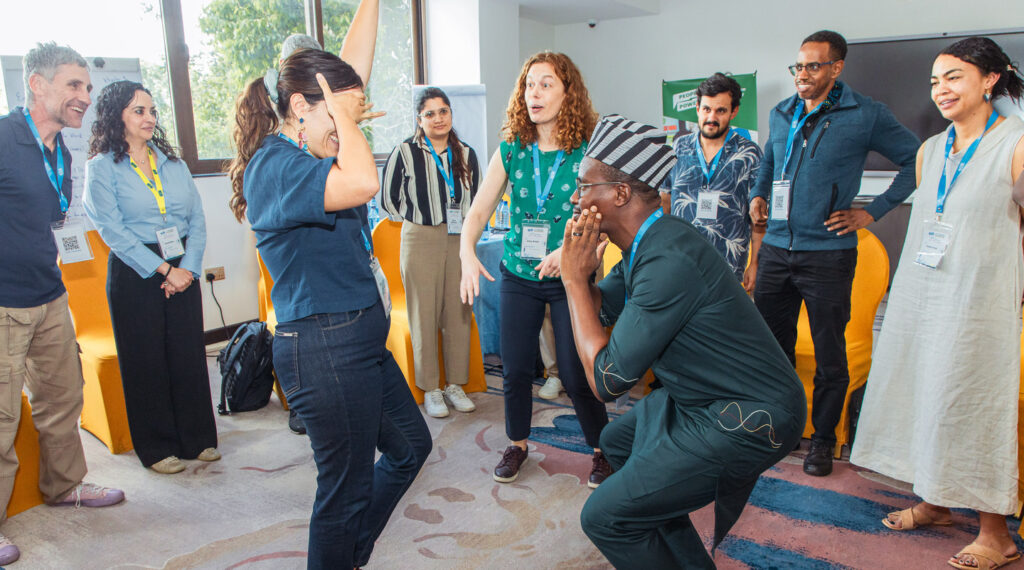
How, then, can emotions become a central part of our democratic practices? This requires an integration of reason, emotion and the body. In traditional deliberative or electoral settings, the body is treated as a mere container for the mind, while emotion, as demonstrated above, is entirely ignored. In a vibrant and inclusive democracy, both should be central. During a recent convening of People Powered: Global Hub for Participatory Democracy in Nairobi, the co-authors led a workshop to explore how embodied learning and play can surface, and transform, these emotional realities. Through practices like Legislative Theatre – a tool rooted in the Brazilian legacy of the Theatre of the Oppressed – communities directly impacted by unjust policies create plays to articulate their struggles. They don’t just report on the problem; they show both the feeling and the nuanced everyday experience of the problem. Audiences of citizens and policymakers, now activated through mutual understanding, are invited to step on stage to rehearse solutions, testing new strategies through physical improvisation.
Local councils, national government and community groups – from the Austrian Ministry of Social Affairs to the local government of Bujaru, Brazil – are increasingly implementing Legislative Theatre processes on issues including housing and homelessness, labour rights and the climate crisis. Institutions turn to such embodied, arts-based policymaking practices particularly when tensions are high; when the lived experience of the policy problem is not fully understood by policy-shapers; when the people most impacted by the issues don’t feel welcomed into formal governance spaces; or when out-of-the-box, totally radical and creative ideas are needed.
In these spaces, emotion acts as a bridge. Aesthetic practices allow policymakers to understand the urgency of a housing crisis not as a statistic, but as a shared human reality. This generates a solidarity often missing from purely verbal deliberations. It allows stakeholders with different levels of formal authority to imagine and test solutions as equals: as comrades affected by a shared challenge. Furthermore, centring emotional realities opens a vital space for laughter. Laughter, in a democratic setting, is a sign of recognition and a release of tension. Most importantly, it communicates a sense of openness to surprise, which encourages participants to think beyond “what is” toward the radical “what could be.” It allows for a non-linear approach where mistakes are welcomed as part of the creative process. More democratic practices, whether arts-based or otherwise, might reconsider their designs to allow such emotions the space to flourish.
Finally, we must ask: what is the role of philanthropy in this shift? Philea’s vision of a ‘public-benefit’ ecosystem – networks of non-governmental, purpose-driven foundations working together for the common good – is uniquely positioned to support the re-shaping of democratic spaces which value and engage with unheard emotions. Unlike governments, often bound by rigid technocratic structures, philanthropy has the risk capital to invest in the intangible. Purpose-driven foundations might fund aesthetic and creative infrastructures that enable an embodied and enthusiastic democracy. It can support the long-term, non-linear work of building shared understanding and collective problem-solving, rather than demanding immediate, quantifiable solutions that ignore the emotional roots of the crisis.
In this democratic future, reason is not an arbiter that silences the heart, but a cartography that helps us understand our emotions so we can act to transform our realities together. If we truly wish to reverse democratic backsliding, we must stop treating unheard emotions as noise and start treating them as choral music.
Authors