Hungary’s turning point: Civic mobilisation beyond civil society
Last year, at a gathering of community philanthropy practitioners in Kenya, I found myself in a conversation that has stayed with me. Across very different contexts, colleagues described a similar shift. NGOs, grassroots and philanthropic organisations were increasingly labelled, contested and treated as political actors, not necessarily because their missions had changed, but because the environments around them had.
Hungary offers a particular example of this dynamic, where civil society itself did not become more political, but the environment around it did.
For 16 years, Viktor Orbán’s government built what is often described as an illiberal system: formally democratic, but increasingly centralised in practice. Independent institutions weakened, media pluralism narrowed and civil society was gradually pushed into a defensive position through changes in rules, control over resources and reshaped public narratives.
In this environment, civil society adapted. The legitimacy of NGOs became tied to their distance from politics. Many organisations moderated their language or avoided public confrontation while continuing to address needs the state could not or would not respond to. Their work remained essential but increasingly disconnected from public visibility and broader recognition.
Philanthropy adapted as well. Domestic donors, particularly companies, became more cautious, often limiting support to causes unlikely to be perceived as political. Meanwhile, much of the sector became dependent on international funding, especially from the European Union and earlier from US sources. This support was often vital for organisational survival, but it also came with constraints. Much of it operated through project-based frameworks with predefined objectives and limited flexibility.
Over time, this shaped not only what organisations did, but how they understood their role. The result was a civil society that remained active, but increasingly constrained in how it could act, speak and take risks.
This unfolded alongside a broader social shift. For years, the system rested on a tacit exchange: reduced agency in return for stability and gradual economic improvement. That exchange slowly began to erode. Inflation rose sharply, public services deteriorated, and a growing sense of insecurity spread across society. Even relatively secure people no longer felt the future could be taken for granted.
Political systems can absorb dissatisfaction for long periods. They struggle more when the stories they tell about reality no longer match lived experience.
The political shift that followed in 2026 is often explained through campaign dynamics or the emergence of Péter Magyar as a new political actor. These factors matter, but they are not the whole story.
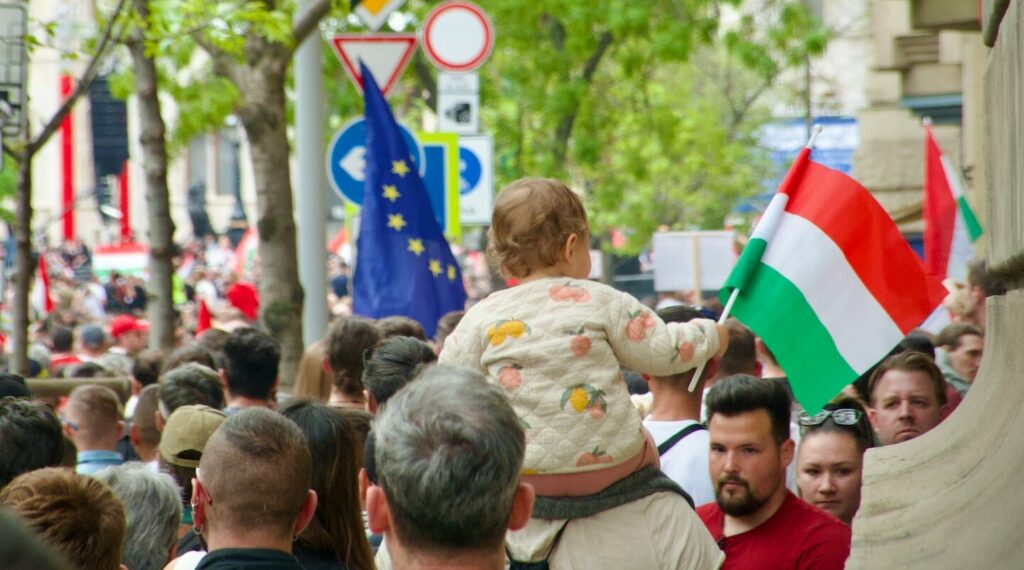
In the months leading up to the election, informal local groups began to appear across Hungary. They became known as “Tisza islands,” though the name matters less than the form they took. These groups had no formal structure, stable funding, or long-term strategy. Many began simply with people gathering to talk and organise locally.
Over time, these scattered interactions became more deliberate. People learned how to speak across political divides and create spaces where conversation again felt possible. What emerged was not a traditional movement, but a relational civic infrastructure built through direct human contact.
Péter Magyar’s campaign intersected with this reality at a particular moment. His decision to travel extensively across the country and engage directly with people created a bridge between dispersed local experiences and a shared political narrative. In a heavily distorted media environment, physical presence itself acquired political significance.
By the final phase of the campaign, these local groups played a visible role in mobilisation efforts. They organised conversations, reached out to voters, and sometimes monitored election processes, forming a pattern of engagement that proved difficult to counter.
What is striking in hindsight is that much of this mobilisation unfolded largely outside the field of organised civil society and philanthropy. It was not driven by programmes, institutions, or funding frameworks. At the same time, many of these informal groups were built by people who had previously participated in community organising or local civic initiatives, drawing on relationships and skills developed through earlier civic engagement. The mobilisation emerged independently of organised civil society, but was not entirely disconnected from it.
Something important happened in this process. For many people, this was the first direct experience in years that collective action was still possible: that people could organise, cooperate across differences and achieve a shared goal even in a highly constrained environment. Experiences of agency replaced long-standing patterns of passivity. New connections formed across a deeply polarised society. This may prove to be one of the most important outcomes of this moment.
For philanthropy and organised civil society, however, this raises difficult questions.
If new civic energy is emerging through informal, local, and highly adaptive forms of participation, what is the role of institutions shaped by very different constraints?
Organised civil society may not create moments of mobilisation like this. But it may help determine whether they last. What institutions can offer is not spontaneous activation, but continuity: the ability to hold processes over time, connect fragmented efforts, preserve knowledge, and provide support once the initial political momentum fades.
At the same time, there is a real tension here. The forms of mobilisation that proved effective were informal, relational and adaptive. Philanthropy, by contrast, often operates through frameworks, criteria, reporting structures and predefined outcomes designed to ensure accountability and control.
Bringing these worlds together is not straightforward.
This became particularly visible in conversations with international partners after the election. One question repeatedly emerged: how can this momentum be captured?
It is an understandable question, but it also reveals a certain distance. Much of the civic energy that shaped this moment did not emerge through structures that can easily “capture” anything. The risk is that, in trying to support it, we reshape it into something more familiar and in doing so weaken the very qualities that made it effective.
For those outside Hungary asking how populist systems can be challenged elsewhere, this offers a sobering lesson. The answer does not lie primarily in better messaging or more sophisticated campaigning. These matter, but they are not decisive on their own.
What matters is whether civic capacity exists when political conditions begin to shift. That capacity does not always take institutional form. It often exists in informal networks, local relationships and accumulated experiences of collective action that remain largely invisible until they suddenly become politically relevant.
Hungary’s experience suggests that this layer of civic life deserves far more attention than it currently receives.
For international philanthropy, this may require a different role than the one often associated with democratic transitions or civil society development. Rather than primarily funding short-term mobilisation or predefined projects, the challenge may be to strengthen the civic conditions that allow collective action to emerge in the first place. In Hungary, this could mean supporting intermediaries that build domestic philanthropy and local giving cultures, creating spaces for learning and exchange, and maintaining a long-term perspective that allows organisations, relationships, and ideas to develop over time. There are no ready-made models for this. But Hungary’s experience suggests that much of what matters may already exist outside formal structures, in relationships and local networks that only become visible once societies begin to move again.
Authors