Beyond defence: New strategies for renewing democracy
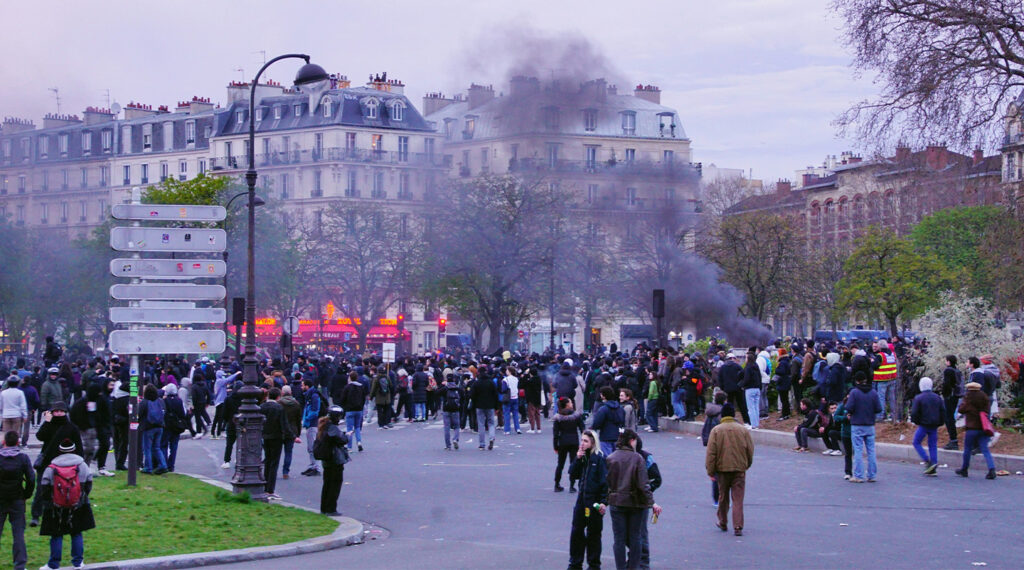
Faced with rising attacks on democracy, the EU has raised a Democracy Shield. Philanthropies have likewise focused on defence, on protecting existing institutions. Marching into battle with only a shield, however, is a recipe for defeat. To reverse democratic backsliding, we also need to embrace new strategies for renewing and expanding democracy.
Philea’s Democracy Briefer identified crucial ways to reverse the drivers of backsliding. The Democracy Shield has integrated some of these lessons, such as support for local participatory programmes. The next step is to go beyond a reactive approach, by adding more proactive strategies:
- Horizons: Envision and start building the desired future of democracy
- Ecosystems: Build bridges, infrastructure and narratives to connect existing efforts
People have valid frustrations with the status quo of democracy, which often feels unresponsive, elitist and self-serving. If people don’t like their current version of democracy, we need to acknowledge these critiques and offer something better. Philanthropies can help build a beautiful future of democracy. Here’s how.
Envision future horizons
If the status quo is deeply flawed, how do we transition to better future democracy? Programmes such as PACE’s Democracy Futures Project are helping funders think longer-term. Through this series of workshops, over 60 funders are learning trend-spotting and foresight skills, while building shared visions of the future of democracy. PACE and others are using the Three Horizons framework to understand what to keep from the current system, what emerging practices to explore and what seeds of future change to support.
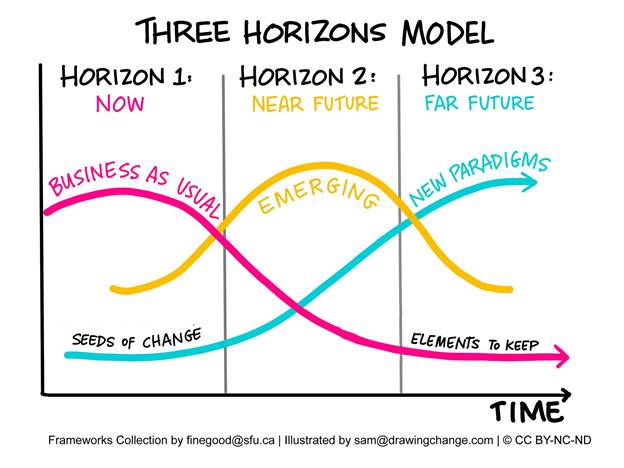
Horizon One is the current ‘business as usual’ system. This accounts for most democracy funding, to support work such as elections, voting rights, voter engagement and education, rule of law and government oversight.
Horizon Two is the emerging new practices of democracy that are visible now. This includes citizens’ assemblies, participatory budgeting, digital participation tools and other democratic innovations. These efforts move us closer to more effective and equitable systems. Trying out new practices also sparks new ideas about what else we might do.
Horizon Three requires greater imagination, since it involves new systems that do not yet exist. To invest in this work, we need to support experiments and prototypes with a high risk of failure. Like for research and design in other fields, this requires testing a wide range of possible solutions, in different ways and contexts and then making long-term investments to carry them out.
Gideon Lichfield, former editor in chief of Wired, offers a glimpse into what horizon three might involve, with the future story of Sandra. In his imagined scenario, Sandra’s personal digital assistant seamlessly points her to relevant neighbourhood discussions and national legislation, directly feeds her input (alongside that of many others) to government representatives and participatory programmes, and alerts her to the outcomes and next steps. Bits of this future are already possible today, but they need nourishment to grow.
Investing in longer-term future horizons can create enticing paths forward for democracy. But what kind of investments move us along these paths?
Build connected ecosystems
When democracy funders look to the future, they usually focus on innovation. What new and sexy practice can get us out of our malaise? Unfortunately, this is part of the problem. No single innovation will eliminate the drivers of democratic backsliding or create future horizons for democracy, on its own. Shifting from one innovation to another comes at the expense of long-term systemic change. The only solution is many solutions, connected together.
I outline emerging strategies for connecting democracy solutions in my white paper From Waves to Ecosystems: The Next Stage of Democratic Innovation. In the past, we built up competing waves of democratic innovation. Advocates are now transitioning to a new approach: weaving different democratic practices into balanced democratic ecosystems.
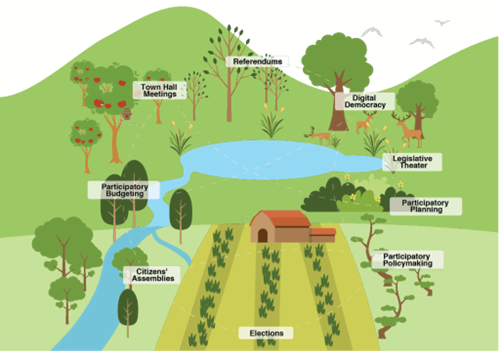
A healthy and connected ecosystem of democracy, from the white paper From Waves to Ecosystems.
What do democratic ecosystems look like in practice? In Paris, the City Council launched a permanent citizens’ assembly, citizens’ juries and participatory budgeting, which work together to help the Council better represent and serve residents. In Brazil the federal government has used national public policy conferences to engage millions of people in deciding key policies and a national digital platform to connect participatory policymaking efforts.
How can philanthropies help turn democratic innovations into system change? A few approaches have been most promising:
- Connections: Supporting new ways to combine or link democratic practices and movements. First, by connecting different kinds of democratic processes, such as training political candidates to use participatory methods and integrating citizens’ assemblies and legislative theatre. Second, by connecting democratic practices across geographic scales, such as the Global Citizens’ Assembly that links local and international assemblies. Third, by connecting democracy and issue-based movements, such as the Democracy for Transition Coalition that brings together democracy and environmental organisations.
- Infrastructure: Funding common staffing and support for different democratic practices and movements. Rather than supporting separate campaigns for electoral reform, voter engagement, citizens’ assemblies, and participatory budgeting, encourage cross-cutting democracy coalitions, resources and programmes. For example, the Open Government Partnership’s Multi-stakeholder Forums convene civil society groups and government officials to agree on governance reforms. Likewise, supporting digital participation tools can help practitioners integrate and streamline democratic practices.
- Narratives: Developing shared language to communicate what democracy is and what it could be. Much advocacy for democracy is technocratic, promoting rule changes, institutional reforms and complex processes. This may motivate experts, but not broader movements. Increasingly, advocates are researching more compelling narratives to build support. The new Democracy Narratives Alliance is synthesising this research, turning it into concrete messaging for engaging people, and applying this new language through coordinated global communications.
Toward new strategies
Most democracy funders have focused on short time horizons and isolated programs. In contrast, anti-democratic donors have used the strategies above, with immense success. They have invested in radical long-term visions and built connective infrastructure at the national and global scale. While democracy funders experiment with one-off pilot programs, anti-democracy donors have built global movements with transformative 30-year time horizons.
It doesn’t have to be this way. It’s time for democracy funders to support longer term visions and build connected ecosystems. When democracy is under attack, defence is not enough. We also need to build a better democracy.
Authors