Anticipatory leadership is in demand
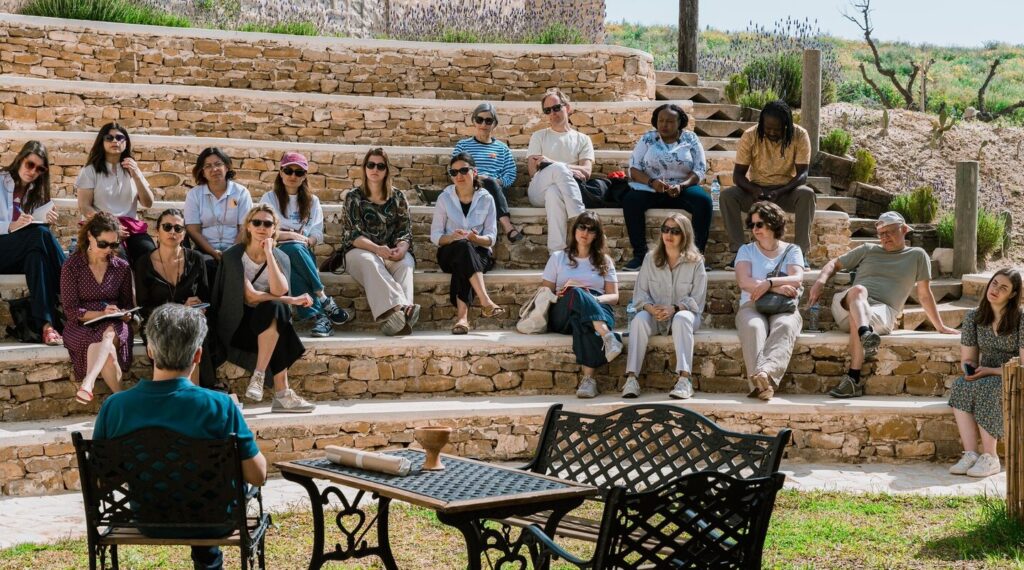
In early October, I came home from Tilal Utique in Tunisia, where Philea and the Kamel Lazaar Foundation had gathered the second cohort of the Futures School Leadership Journey. The day after we closed, the Robert Bosch Stiftung announced that Atje Drexler, a member of Philea’s board and an alumna of our first cohort, would become its CEO.
Her appointment is part of a larger pattern. Within a year, five more alumni and one of our partners have taken on larger roles, in Istanbul, Copenhagen, Bucharest, London, and Cape Town. It is striking that several of these newly appointed leaders have also invested in foresight and anticipatory approaches. While their appointments reflect a much broader range of experiences and capabilities, this may point to the growing relevance of these skills in navigating uncertainty. These choices reveal a quiet shift in what philanthropy asks of its leaders. Each of the seven brings unique strengths, but I see five qualities they share.
The first is curiosity and openness to opportunity. This is not naivete but the skill of noticing weak signals, the early signs of change, often in the hardest circumstances. Rana Tutcuoğlu, now General Manager of the Sabancı Foundation, showed it as Secretary General of TÜSEV, the Third Sector Foundation of Türkiye. With her team, she brought together donors, non-profits and experts in fields from AI to next-gen to sports philanthropy. Rather than lament the familiar story of shrinking funding, they asked where civic action was thriving and where resources were being mobilised in new ways.
Curiosity is also the antidote to what EU horizon scanners recently flagged as “strategic institutional ignorance”: the deliberate choice to ignore inconvenient knowledge. Under pressure, institutions are tempted to look away or centralise decision-making. Curious leaders go looking for what they do not know and would challenge their assumptions.
The second is “hearing collectively” to build a shared understanding. In Tilal Utique, Ksenia Zheltoukhova, an alumna who is now Chief Strategy and Transformation Officer at Luminate, reminded us that a strong vision is not enough: a team commits to a future only when it has helped to imagine it. She brought Ryuhei Matsuo’s painting Floating Woman, a figure suspended in an empty room, as a metaphor for the space between now and the future. It feels uncomfortable, and leaders are tempted to leave this messy “in-between” too soon. Yet that is where shared understanding takes shape. Mmabatho Maboya, now Chief Operating Officer of the African Climate Foundation, calls this “collective hearing”, and insists it must be inclusive of an organisation’s leadership, from the board to the operational and executive teams.
The third is rigour and depth. Foresight does not come from compelling visions alone. We do not lack stories of the future; we lack the ability to translate them into processes, funding strategies and budgets. It emerges when new insight meets deep knowledge and disciplined implementation. Atje Drexler embodies this. In 25 years at the Robert Bosch Stiftung, she has worked across health, global issues, foresight and impact measurement.
This breadth of experience illustrates how anticipatory thinking can complement deep institutional knowledge, strategic judgement and the ability to translate insight into action. Having built its Futures and Networks department, she helped shape, under the leadership of Bernhard Straub, whom many know for his servant leadership style and for enabling a culture of trust and innovation, an opportunity-driven strategy for the foundation. This strategy looked at the pressures facing civil society in Germany and beyond over the next years, while leaving room for what is possible, and then turned that insight into the organisation’s capacity to act. Dozens of colleagues volunteered beyond their roles to take part.
The fourth is embracing uncertainty while insisting that a different future is possible. Years ago, I was struck by Sine Egede’s title at Bikubenfonden: Chief Visionary Officer. Now its incoming CEO, she has helped make the Copenhagen foundation, a Futures School partner, a place that rehearses possible futures. With partners and neighbours, it turned a 1960s warehouse in one of the city’s poorest districts into Thoravej 29, a shared home for civil society, guided by one rule: whatever can be reused must be reused. Its grantmaking follows Bill Sharpe’s Three Horizons framework, funding the messy second horizon between today’s system and the future we hope for, with Jakob Schjørring, now Director of Missions, holding the portfolio together. Under Søren Kaare-Andersen and Sine Egede, this has become the foundation’s culture: taking on complex, systemic challenges and acting even when the future is unknown. Sharpe calls it “future consciousness”.
The fifth is humility. In Tilal Utique, Arafat Adhadhi of the Kamel Lazaar Foundation spoke about tawāḍuʿ, a profound value across the Arab world: “Humility is not weakness, nor self-deprecation… it is knowing your own worth, while recognising, at the same time, the worth of the person standing beside you.” Suzana Dobre, now President of the Romanian-American Foundation, leads this way. Speaking to our new cohort, she said that “over the years, I learned to suspend myself to find agency from other perspectives and views.” She also builds on what her predecessor Roxana Vitan began: seven-to-ten-year bets on rural Romania and community philanthropy. Humble leaders do not start from zero.
Why does this matter now? Many foundation strategies were written for a world that no longer exists. The dismantling of USAID, cuts to European aid and cascading crises have added to the pressure on civil society. Philanthropy is quietly reimagining a qualified leader: no longer only someone who executes a five-year plan, but someone who can invite diverse views, sit with discomfort and still turn insight into change. The five qualities are, at heart, tensions: openness and rigour, uncertainty and conviction, one’s own worth and that of others. Foresight does not resolve them; it helps leaders hold these tensions simultaneously. American novelist F. Scott Fitzgerald put it into words, and I think this parallel with anticipatory leadership is striking, “the test of a first-rate intelligence is the ability to hold two opposed ideas in the mind at the same time, and still retain the ability to function.”
These seven are not heroes. They are leaders empowered by boards and teams willing to hear collectively, sit in the in-between and fund the second horizon. They are signals of a larger shift: anticipatory leadership is in demand.
Authors