
Pioneering Just Transitions – How the Laudes Foundation leverages finance, evidence and partnerships for long-term impact
Section
Case in Brief
The issue
Fashion, food and the built environment generate 80% of global emissions, making their decarbonisation critical to combating the climate crisis. These sectors employ millions worldwide, so their transition must support workers and communities, as well as nature. Without specifically focusing on the need for a collective and equitable approach to transformation, we risk deepening inequalities.
The context
The post-Covid era revealed the complexities and long-term challenges of the current system of capitalism. Industries need practical solutions for how best to reduce emissions while prioritising equitable and sustainable outcomes for both people and nature. The concept of a “just transition” unites this dual goal, emphasising fairness in industrial transformation with the need to integrate social and environmental considerations.
The path forward
Laudes Foundation envisions a future where transitions are designed to benefit both workers and the environment, meaning that industries are decarbonised, and communities are empowered. Achieving this vision involves leveraging financial systems to drive change within industries and fostering a cultural shift toward sustainability. Such a systemic transformation may take 15 years or more, but Laudes is committed to building momentum and delivering meaningful progress.
The Laudes Foundation: A Snapshot
The Laudes Foundation was launched in 2020 by the Brenninkmeijer family, and builds on 200 years of entrepreneurial and philanthropic efforts. It seeks to address climate change, biodiversity loss and inequality by driving systemic change across industries, focusing on the high-emitting industries of fashion, food, the built environment and finance. Its mission to foster a green, fair and inclusive economy is amplified by supporting innovation and working with partners to create positive systems change.
Mindset
- Experiment
- Build the field
- Connect unlikely allies
- Form communities of changemakers
Overview
Working alongside a wider network of philanthropic organisations, including its counterpart, Porticus, Laudes challenges and inspires industry to harness its power for good. Laudes’s commitment to tackling climate change, nature loss and social inequality is driven by the belief that business and industry can be challenged by philanthropy to use their market power for positive change. Underpinning this mission, Laudes employs 6 strategic approaches to help achieve the greatest impact:
- Accelerating advocacy
- Strengthening accountability
- Scaling research and innovation
- Cultivating alliances
- Amplifying narratives
- Redefining value
Laudes goes beyond traditional grantmaking, using the catalytic power of philanthropy to actively unite business, policymakers, investors and civil society in enduring partnerships to advance systems change. As a prime example, Laudes co-created an Economic System Map with Nexial, harnessing insights from senior leaders, changemakers and experts across more than 130 organisations globally. The map creates a visual network that not only highlights the challenges faced by changemakers, but also how they can better coordinate action towards a just transition.
Challenge
Businesses are operating in an uncertain environment that is constantly changing alongside rapidly evolving regulations. A balance between maintaining long-term strategic visions and addressing immediate priorities is urgently needed. Laudes applies a mindset that embraces complexity and seeks innovative solutions. By diving deeply into critical topics, seeding ideas and encouraging diverse stakeholders to come together, Laudes can foster collaboration and bridge divides between different disciplines to address systemic issues effectively.
Laudes’s initial five-year strategy provided a structured roadmap for driving change, but global disruptions such as Covid-19, geopolitical shifts, and economic uncertainty exposed the limitations of having a set strategy. The implementation of a strong theory of change is complex, requiring adjustments and a need for agility, and being able to adapt quickly. Industry shifts are interconnected and unpredictable, necessitating an agile approach considering how action in the short-term can have medium-term effects. Laudes recognised the need for a more dynamic strategy to bridge the gap between looking back and learning and applying foresight to anticipate what is to come.
By taking a more strategic approach, Laudes has refined its strategy to factor in short-term, data-driven actions alongside long-term systemic change, as outlined below.
This revised framework emphasises both short-term agility and long-term vision, ensuring that Laudes’s philanthropic investments remain impactful, adaptive and aligned with an ever-evolving global context. This long-term approach is particularly evident in Laudes’s efforts to transition the fashion industry away from fast fashion. By producing billions of garments that quickly end up in landfills, the fast fashion industry is facilitating massive environmental harm. According to an article in the Harvard Business Review, some brands’ emissions jumped 52% in 2022, totalling 9 million tons of CO2. In addition, the industry relies on exploitative labour practices, with some workers earning less than four cents per garment and enduring 18-hour workdays.
By highlighting the urgent need for ethical and sustainable reform, Laudes has positioned itself as a vital force in shifting the narrative around fast fashion, encouraging brands and their financiers to engage in more sustainable practices and reshaping the industry for a more sustainable future.
Approach
Influencing the behaviour of huge industries is undeniably complex, but there remains optimism about the potential for transformation. Laudes begins by understanding economic systems, focusing on different stakeholders across the economy – government officials; investors and financiers; business leaders; the workers, producers and their communities; and media practitioners. Mapping the factors that influence the economy provides valuable insights into how change within this intricate system can be achieved.
Laudes employs a model similar to the “Three Horizon Life Cycle” to manage its partnerships and choose new partners. This involves exploring and learning from early-stage projects (e.g. exploratory grants for food systems transformation); accelerating and continuing successful longer-term initiatives with core support; and exiting or transitioning from projects responsibly.
This approach results in effective partnerships, amplifies impact and enables learning from these efforts. Laudes’s strength lies in fostering collaboration, seeding innovative ideas, setting up lighthouse projects – such as Built by Nature – as well as convening other donors around the key issues central to their work, like the Just Transition Donors Alliance.
Laudes doesn’t just hand out grants to projects and partners, but helps them build resilience, enhance skills and develop networks and organisational capabilities. Through its Learning Fund, partners can access funding for collective learning and knowledge-sharing initiatives. Its collaboration with Non-Profit Builder enables partners to access support on anything from VAT returns to communications or fundraising. Additionally, its Resilient Partners initiative helps organisations address well-being challenges and provides flexible assistance in response to security, economic and health risks.
Results
Laudes uses a rubrics-based methodology to help understand and measure its contribution to systems change, while still learning and adapting to new and unforeseen circumstances. Change cannot be captured by numbers alone: Metrics focus on what can be counted rather than what’s most important, but rubrics also set a framework for what “good” looks like. This establishes a shared language for describing and assessing outcomes using both quantitative and qualitative evidence. Laudes’s rubrics are integrated into its grantmaking processes – from the design phase through to measurement, evaluation and learning.
Laudes works with its partners to catalyse change by empowering them and building their capacity. Through building and funding “lighthouse projects” like Built by Nature and Fashion for Good, it effectively leverages expertise and resources to address pressing challenges:
Built by Nature: Transforming the built environment
Established in 2021, Built by Nature is a grantmaking network aimed at integrating bio-based materials into the construction industry. With additional funders having joined the initiative, the network has mobilised €25.8 million to advance its mission. Built by Nature has contributed to major policy advancements, such as the EU’s recognition of carbon storage in buildings within its new carbon removal framework, which incentivises investment in sustainable innovations. Moreover, the Built by Nature Prize highlights scalable, market-ready, bio-based construction solutions, demonstrating the growing momentum for environmentally aligned architectural practices.
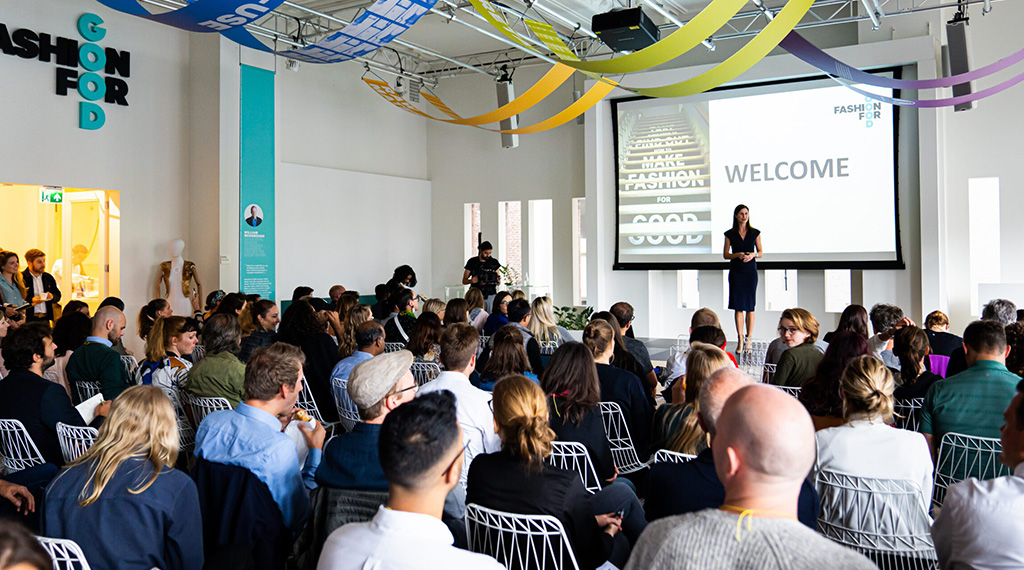
Fashion for Good: Pioneering circular innovation in fashion
Fashion for Good is at the forefront of transitioning the fashion industry from a ‘’take-make-waste’’ pattern to a circular and regenerative model. It nurtures and scales innovations through its accelerator and scaling programmes while driving systemic change through long-term foundational projects and impact investments. The fashion industry is responsible for significant environmental and social impacts, with 60% of materials being oil-based and 85% of fashion waste ending up in landfills.
This collaboration focuses on decarbonising the sector, promoting circularity and scaling sustainable materials, while supporting inclusive policies and leadership to drive systemic change. The partnership has also fostered industry-wide collaboration via the Circular Apparel Community and raised public awareness with the now closed Fashion for Good Experience, an interactive museum in Amsterdam. These multifaceted efforts aim to make sustainability integral to the fashion industry, from consumer awareness to supply chain transformation, embodying the principles of restoration and regeneration.
Coolfood Pledge: Reducing the food industry’s carbon footprint
One of Laudes’s newer endeavours is to support the transition of the food industry – a notoriously complex sector – toward decarbonisation by focusing on demand-side interventions. Since 2019, the Coolfood Pledge has driven meaningful progress in reducing the food industry‘s carbon footprint, achieving a 10% reduction in greenhouse gas emissions per plate through to 2022 despite challenges like the cost-of-living crisis and the pandemic. Given that the global food system accounts for one-third of total greenhouse gas emissions, this initiative marks a significant step toward a more sustainable, inclusive and health-focused industry, demonstrating the power of shifting diets toward plant-based, lower-carbon options. The success of this project underscores the Laudes approach to shifting the standard behaviour of industry.